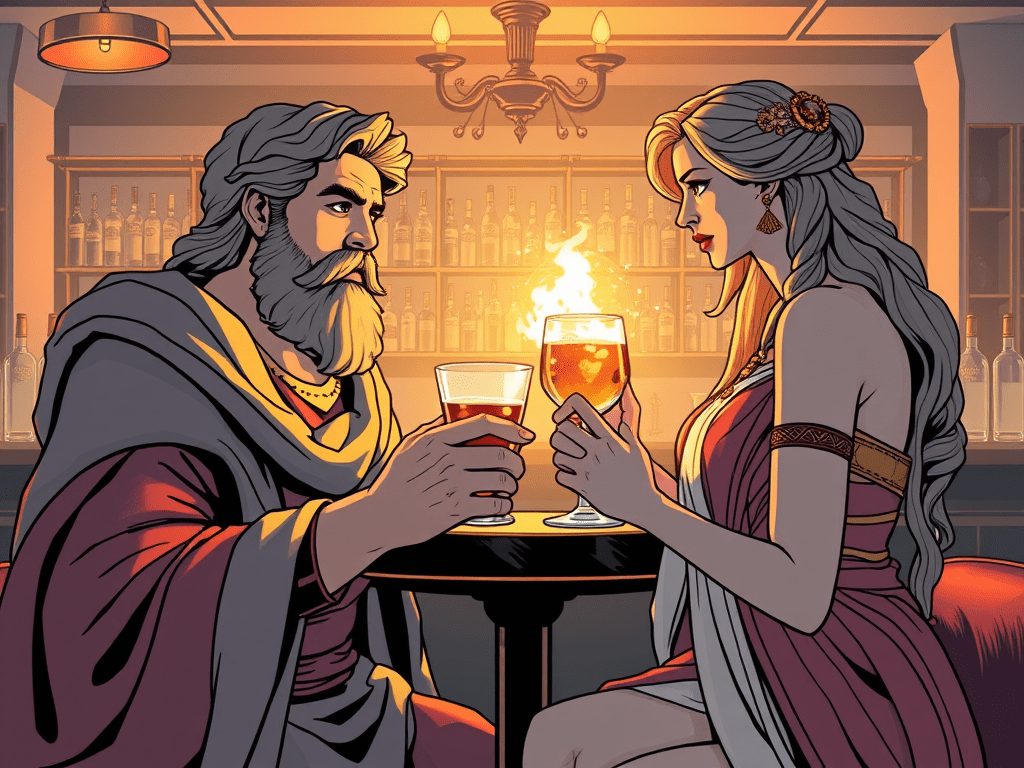
I have a friend who, in a bold and public display of intellectual courage, announced on Facebook that he was finally going to tackle Dante’s The Divine Comedy. My immediate thought was, “Oh, bless your heart.” My second was to wonder if he knew what he was really getting into. Because while most people see it as a stuffy medieval poem about a guy who gets to peek into hell, I see it as a very specific, and perhaps rather rude, invitation to think about a conversation we rarely have: What happens when the cold, hard facts of logic and the soaring, unprovable truths of faith are forced to have a drink together? What if they had to navigate your life together?
Dante gives us the original buddy comedy duo. On one side, you have Virgil, the consummate man of reason. He’s the Roman poet who represents the pinnacle of human intellect – logic personified. He’s your tour guide through hell and purgatory, explaining every ghastly punishment and the precise logical reason for it. As he famously tells Dante, “I can explain to you as much as reason sees; for the rest, wait for Beatrice – it is the work for faith.” Virgil is the walking encyclopedia, the guy who can map out morality like a city grid.
Then you have Beatrice, Dante’s muse and the ultimate symbol of divine faith. She’s the one who inspires the entire journey, the unattainable ideal that beckons him toward paradise. She’s the reason why he’s even bothering to do any of this. She doesn’t need logic or reason; she embodies the pure, unadulterated truth of the divine. As the great philosopher Aquinas once said, “The act of faith is not at all unreasonable or without evidence.” It is, in fact, “a logical ascent to the truths that God himself has revealed.”
It’s a magnificent setup. The brilliant, logical mind of Virgil can get you through the worst of it. He’ll explain the mechanics of sin and the moral architecture of damnation, but he can’t take you all the way. He can’t get you to heaven because, for that, you need faith. And faith, personified by Beatrice, needs the logical path laid out by Virgil to even begin her journey.
This is the great cosmic joke of The Divine Comedy. It’s not a map to heaven; it’s a reminder that we can’t get anywhere meaningful without both. You need logic to pay your bills, to understand the physics of the universe, and to avoid walking off a cliff. But you need faith – whether in a higher power, in humanity, or just in yourself – to give those actions meaning.
Our modern world loves to separate these two. We are told they are mortal enemies, destined to be at odds forever. But the truth is, they’re more like two bartenders working the same shift. Logic pours the drink – it analyzes, organizes, and identifies the different levels of sin and virtue. But faith is the conversation – the reason why the drinks are being poured, the ultimate destination, the belief in a truth beyond the measurable. C.S. Lewis, who knew a thing or two about these sorts of things, put it rather well: “Faith is the art of holding on to things your reason has once accepted, in spite of your changing moods.” Logic gives you the starting point, the evidence you can’t ignore. Faith is the sustained commitment, the daily art of returning to that truth even when it’s inconvenient.
You can’t have one without the other. The real insight happens when faith and logic stop fighting and finally have a drink together.
And so, when I saw my friend’s post, I didn’t think he was just trying to prove something. I realized he’s in his own purgatory, looking for a way out. He’s not just reading a book; he’s looking for a map, a way to make sense of the absurdity of it all. And what better guide for that journey than a guy who walked through hell with his head on straight and his heart on fire? Maybe that’s what we’re all doing, after all. We’re all just trying to have logic and faith share a drink, hoping that by the end of it, we’ll finally know where we’re going.
 Justin Lockridge
Leave a comment